






Victron Lithium Battery 12VDC 200Ah Smart LiFePO4 [BAT512120610]
Our Price: $1,561.45
What's this?
Lithium Battery 12VDC 200Ah Smart LiFePO4
Lithium-iron-phosphate (LiFePO4 or LFP) is the safest of the mainstream li-ion battery types. The nominal voltage of an LFP cell is 3,2V (lead-acid: 2V/cell). A 12,8V LFP battery, therefore, consists of 4 cells connected in series; and a 25,6V battery consists of 8 cells connected in series.
Lithium Batteries require additional components during installation to make the system operate properly. These should be professionally installed to help avoid costly non-warranty failures.
Rugged
A lead-acid battery will fail prematurely due to sulfation:
- If it operates in deficit mode for long periods of time (i.e. if the battery is rarely, or never at all, fully charged).
- If it is left partially charged or worse, fully discharged (yacht or mobile home during wintertime). An LFP battery does not need to be fully charged. Service life even slightly improves in case of a partial charge instead of a full charge. This is a major advantage of LFP compared to lead acid.
- Other advantages are the wide operating temperature range, excellent cycling performance, low internal resistance, and high efficiency (see below).
LFP is therefore the chemistry of choice for very demanding applications.
Efficient
In several applications (especially off-grid solar and/or wind), energy efficiency can be of crucial importance. The round trip energy efficiency (discharge from 100% to 0% and back to 100% charged) of the average lead-acid battery is 80%. The round trip energy efficiency of an LFP battery is 92%. The charge process of lead-acid batteries becomes particularly inefficient when the 80% state of charge has been reached, resulting in efficiencies of 50% or even less in solar systems where several days of reserve energy are required (battery operating in 70% to 100% charged state). In contrast, a LFP battery will still achieve 90% efficiency under shallow discharge conditions.
Size & Weight:
Saves up to 70% in space. Saves up to 70% in weight.
Expensive?
LFP batteries are expensive when compared to lead-acid. But in demanding applications, the high initial cost will be more than compensated by longer service life, superior reliability and excellent efficiency.
Please contact your dealer for any returns, repairs or support issues related to this product.Quick Guide (pdf)
Lithium Battery 12VDC 200Ah Smart LiFePO4
Lithium-iron-phosphate (LiFePO4 or LFP) is the safest of the mainstream li-ion battery types. The nominal voltage of an LFP cell is 3,2V (lead-acid: 2V/cell). A 12,8V LFP battery, therefore, consists of 4 cells connected in series; and a 25,6V battery consists of 8 cells connected in series.
Lithium Batteries require additional components during installation to make the system operate properly. These should be professionally installed to help avoid costly non-warranty failures.
Rugged
A lead-acid battery will fail prematurely due to sulfation:
- If it operates in deficit mode for long periods of time (i.e. if the battery is rarely, or never at all, fully charged).
- If it is left partially charged or worse, fully discharged (yacht or mobile home during wintertime). An LFP battery does not need to be fully charged. Service life even slightly improves in case of a partial charge instead of a full charge. This is a major advantage of LFP compared to lead acid.
- Other advantages are the wide operating temperature range, excellent cycling performance, low internal resistance, and high efficiency (see below).
LFP is therefore the chemistry of choice for very demanding applications.
Efficient
In several applications (especially off-grid solar and/or wind), energy efficiency can be of crucial importance. The round trip energy efficiency (discharge from 100% to 0% and back to 100% charged) of the average lead-acid battery is 80%. The round trip energy efficiency of an LFP battery is 92%. The charge process of lead-acid batteries becomes particularly inefficient when the 80% state of charge has been reached, resulting in efficiencies of 50% or even less in solar systems where several days of reserve energy are required (battery operating in 70% to 100% charged state). In contrast, a LFP battery will still achieve 90% efficiency under shallow discharge conditions.
Size & Weight:
Saves up to 70% in space. Saves up to 70% in weight.
Expensive?
LFP batteries are expensive when compared to lead-acid. But in demanding applications, the high initial cost will be more than compensated by longer service life, superior reliability and excellent efficiency.
Please contact your dealer for any returns, repairs or support issues related to this product.Quick Guide (pdf)
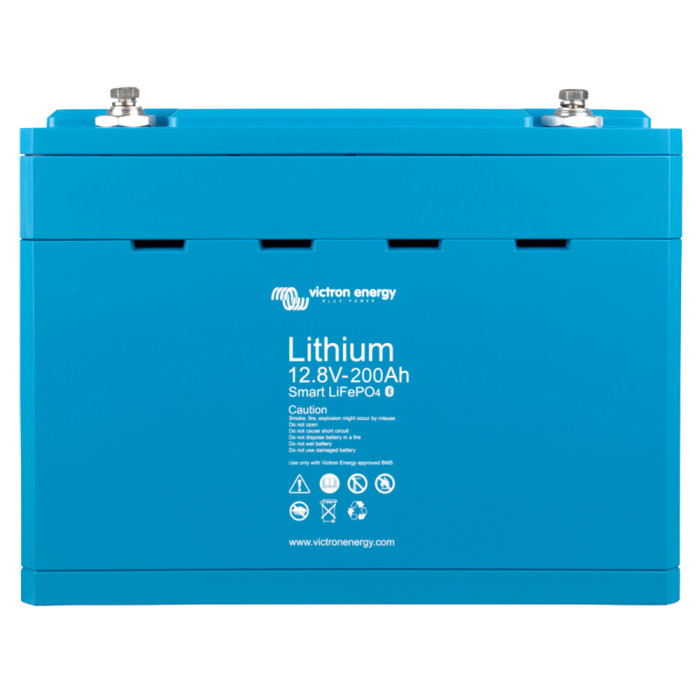
Lithium Battery 12VDC 200Ah Smart LiFePO4
Lithium-iron-phosphate (LiFePO4 or LFP) is the safest of the mainstream li-ion battery types. The nominal voltage of an LFP cell is 3,2V (lead-acid: 2V/cell). A 12,8V LFP battery, therefore, consists of 4 cells connected in series; and a 25,6V battery consists of 8 cells connected in series.
Lithium Batteries require additional components during installation to make the system operate properly. These should be professionally installed to help avoid costly non-warranty failures.
Rugged
A lead-acid battery will fail prematurely due to sulfation:
- If it operates in deficit mode for long periods of time (i.e. if the battery is rarely, or never at all, fully charged).
- If it is left partially charged or worse, fully discharged (yacht or mobile home during wintertime). An LFP battery does not need to be fully charged. Service life even slightly improves in case of a partial charge instead of a full charge. This is a major advantage of LFP compared to lead acid.
- Other advantages are the wide operating temperature range, excellent cycling performance, low internal resistance, and high efficiency (see below).
LFP is therefore the chemistry of choice for very demanding applications.
Efficient
In several applications (especially off-grid solar and/or wind), energy efficiency can be of crucial importance. The round trip energy efficiency (discharge from 100% to 0% and back to 100% charged) of the average lead-acid battery is 80%. The round trip energy efficiency of an LFP battery is 92%. The charge process of lead-acid batteries becomes particularly inefficient when the 80% state of charge has been reached, resulting in efficiencies of 50% or even less in solar systems where several days of reserve energy are required (battery operating in 70% to 100% charged state). In contrast, a LFP battery will still achieve 90% efficiency under shallow discharge conditions.
Size & Weight:
Saves up to 70% in space. Saves up to 70% in weight.
Expensive?
LFP batteries are expensive when compared to lead-acid. But in demanding applications, the high initial cost will be more than compensated by longer service life, superior reliability and excellent efficiency.
Please contact your dealer for any returns, repairs or support issues related to this product.Quick Guide (pdf)
Lithium Battery 12VDC 200Ah Smart LiFePO4
Lithium-iron-phosphate (LiFePO4 or LFP) is the safest of the mainstream li-ion battery types. The nominal voltage of an LFP cell is 3,2V (lead-acid: 2V/cell). A 12,8V LFP battery, therefore, consists of 4 cells connected in series; and a 25,6V battery consists of 8 cells connected in series.
Lithium Batteries require additional components during installation to make the system operate properly. These should be professionally installed to help avoid costly non-warranty failures.
Rugged
A lead-acid battery will fail prematurely due to sulfation:
- If it operates in deficit mode for long periods of time (i.e. if the battery is rarely, or never at all, fully charged).
- If it is left partially charged or worse, fully discharged (yacht or mobile home during wintertime). An LFP battery does not need to be fully charged. Service life even slightly improves in case of a partial charge instead of a full charge. This is a major advantage of LFP compared to lead acid.
- Other advantages are the wide operating temperature range, excellent cycling performance, low internal resistance, and high efficiency (see below).
LFP is therefore the chemistry of choice for very demanding applications.
Efficient
In several applications (especially off-grid solar and/or wind), energy efficiency can be of crucial importance. The round trip energy efficiency (discharge from 100% to 0% and back to 100% charged) of the average lead-acid battery is 80%. The round trip energy efficiency of an LFP battery is 92%. The charge process of lead-acid batteries becomes particularly inefficient when the 80% state of charge has been reached, resulting in efficiencies of 50% or even less in solar systems where several days of reserve energy are required (battery operating in 70% to 100% charged state). In contrast, a LFP battery will still achieve 90% efficiency under shallow discharge conditions.
Size & Weight:
Saves up to 70% in space. Saves up to 70% in weight.
Expensive?
LFP batteries are expensive when compared to lead-acid. But in demanding applications, the high initial cost will be more than compensated by longer service life, superior reliability and excellent efficiency.
Please contact your dealer for any returns, repairs or support issues related to this product.Quick Guide (pdf)
| SKU | CWR-84919 |
|---|---|
| Price | $1,561.45 |
| Brands | Victron Energy |
| Manufacturer's Suggested Retail Price | $1,837.00 |
| UPC | 8719076045526 |